
Introduction
Edgar M. Hoover’s theory of industrial location is an improvement over Industrial Location Theory of Weber. He published his ideas about industrial location in his work titled “The Location of Economic Activity” (1948). His theory seems to be an amalgam of Weber’s Industrial Location Theory, Perroux’s Growth Pole Theory, Myrdal’s Cumulative Causation Theory and Hirschman’s Unbalanced Growth Theory. To be clear, please note that Hoover’s ideas predates Perroux, Myrdal and Hirschman.
Note: Before discussing this theory, it is assumed that the reader has read Industrial Location Theory of Weber. It is essential to read Weber before understanding Hoover.
There are two parts of Hoover’s idea on industrial location. In first part, Hoover tries to determine the location of industries and in later part, he explains the idea of dynamic industrial location due to various factors of centralization and decentralization. Let us discuss Hoover’s industrial location theory in detail.
Industrial Location Theory by Hoover
Initially, Hoover also tried to find the location of least cost for industry, like Weber did. To determine the location of least cost, he makes following assumption
Assumption
- Perfect Competition: There are large number of producers and consumers of a product.
- Perfect Information: The consumers and producers have complete information of prices of different types of cost at different location.
- Economic Men: The producers try to maximize their profits by making rational and economic decisions.
- Uniform Transport Cost: The land is isotropic/plain, therefore, the transport cost increases uniformly in all direction.
Types of Costs
Along with the assumptions, Hoover described cost of production as follows.
- Total Cost: Total cost also represents the price of a commodity. It is sum of transport cost and production cost.
- Transport Cost: Transport cost increases uniformly in all directions from point of production depending on the weight of product. It includes the transfer cost also. In this case, transfer cost is the cost of loading and unloading a product to and from the mode of transport.
- Production Cost: Production cost refers to the cost of raw material, labor and capital.
Determination of Least Cost Location
Since the producers are economic and rational, most producers will locate their industry at a location of least production cost. Therefore, their production cost will be same. Consequently, transport cost act as the sole force determining the industrial location.
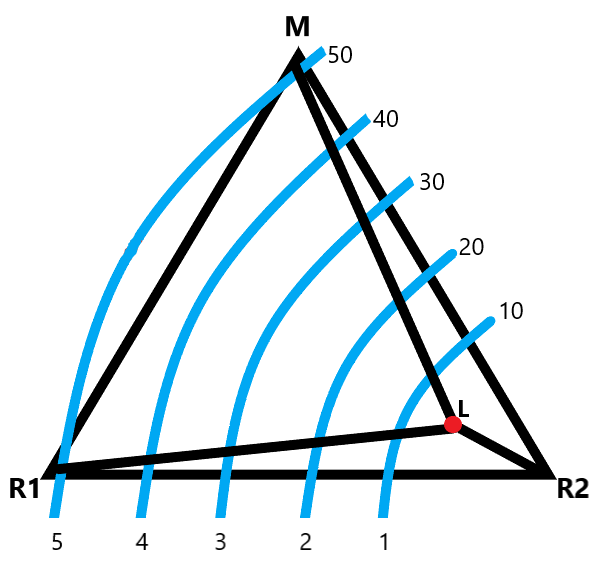
- Hoover tries to find the location of least cost with the help of isotims i.e. lines joining the areas of equal transport cost around a production center.
- With the help of isotims (blue lines in Fig.1), one can easily determine the zone of influence around a production point (see R2 in Fig.1). It is similar to Weber’s locational triangle.
- In contradiction to Weber, Hoover postulates that the producers will not locate his firm at an intermediate location i.e. L (Red dot) in fig. 1 near node R2. He will locate on R2 not near R2 because R2 is a weight loosing product such as iron and steel.
- In other cases, the producer will locate it at either of the three nodes i.e. M, R1 and R2, depending on the nature of product (weight gaining or loosing). It is so because the sources of raw materials (R1 and R2) and Markets (M) are generally fitted with logistical equipment for loading and unloading products. Such equipment is mostly absent or more costly at intermediate location than the source and destination. Hence, nodes will be ideal location for operation of industries.
- Nonetheless, some industries locate at intermediate location between sources of raw material and market. Since, transport cost do not form a large part of price of such industries, their intermediate location is possible. It means they are not transport oriented industries.
- Similarly, Hoover draws the isotims around multiple production centers to draw isodapane for determination of least cost location.
- The zone of influence of a particular production center extends to a point where the transport cost from adjacent production centers becomes same. Hence, it becomes uneconomic for consumer to go further for purchasing goods or services. Hence, the production center maintains its consumer base and stays profitable.
Dynamic Concept of Industrial Location
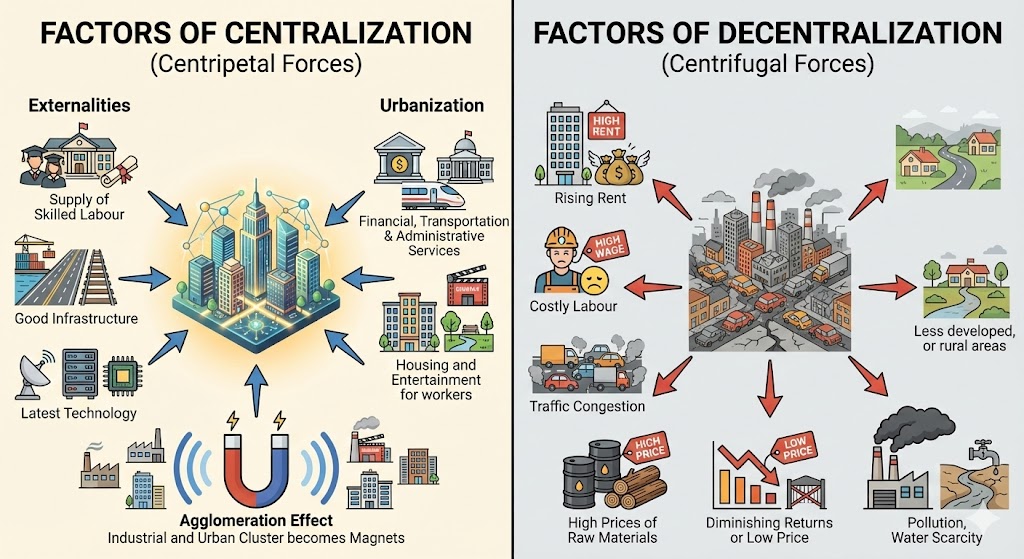
Hoover do not limit himself at determining a fixed location of least cost. He opines that industrial location is a dynamic concept. Many macro and micro economic factors change the ideal location for production and transport. He observes two sets of forces or factors which help determine or change the location of least cost for industries i.e. Forces of centralization and forces of decentralization. In other words, these are factors of agglomeration and deglomeration. Let us discuss these factors in detail (See Fig. 2)
Factors of Centralization
1. Externalities
Externalities are those benefits which a producer gets by just locating his industry in a particular economic space. these benefits do not accrue to the efforts of the producer or its firm. For instance, availability of skilled labor for specialized tasks, availability of latest technology to increase efficiency, cheaper raw materials due to economies of scale to suppliers and coordination between adjacent firms. All these factors provide additional benefits to a firm deciding to locate in a particular locality.
2. Urbanization
The urban landscape provides many such facilities which improve the quality of life of humans. These facilities involve education, health facilities, sports, financial, transport and administrative services. The urban bias among policy makers lead to allocation of greater budget to urban areas, therefore, urban spaces have better living conditions. Thus, entrepreneurs as well as the laborers prefer to live in urban areas. Most urban areas also provide externalities.
3. Agglomeration Effect
When the externalities and urban economies exist at one place, the resulting landscape is called an agglomeration e.g. Delhi National Capital Region, Mumbai Metropolitan Area, California’s Silicon Valley etc. In such spaces, industry, educational institutes and policy makers are very well connected leading to many economic, social and political benefits. So, any new firm have to establish themselves in or near an agglomeration to offer competitive prices to consumers.
Factors of Decentralization
The forces of decentralization pushes the industries and people away from the industrial agglomeration. According to Mumford’s Classification of Cities, the urban area prospers to a certain limit. Thereafter, it starts to decay and becomes a necropolis. Hence, the external benefits stop and city becomes blighted. These factors of decentralization are as follows.
- Rising Rent: The overcrowding of city by firms leads to shortage of land in the city. The demand for land far exceeds its supply. It leads to very high rent. Ultimately, the firms in the agglomeration lose their economic advantages over firms outside agglomeration.
- Costly Labor: There are many factors which leads to rise in wages in an agglomeration. The housing becomes costly, traffic congestion leads to high travel cost for labor, the health of laborers deteriorate due to environmental degradation etc. Ultimately, the cost of good life becomes very high. The labor starts to demand higher wages or look for better opportunities elsewhere.
- Traffic Congestion: The traffic problems leads to rise in transportation cost for both the entrepreneur as well as the laborers. The loss of time along with higher cost makes agglomeration unattractive.
- Reduced Return: The high demand for raw material leads to very high prices of raw materials within industrial clusters. This in combination with other factors make the firms unsustainable in the industrial clusters.
- Technological Changes: Many locational factors become redundant due to technological changes. For instance, the information technology industry may work anywhere in the world given the availability of internet. Therefore, such industries need not cluster. Similarly, development of new and faster modes of transport help producers to locate at alternative locations.
- Policy Changes: Sometimes, the change in government policies forces firms to move away from industrial clusters. For instance, the tax holidays for setting up industry in backward areas may help initiate the development of an alternative industrial cluster.
All these factors lead to overall degradation of economic, political and environmental condition in the urban or industrial agglomeration. Thus, the firms starts to move outwards.
Evaluation and Conclusion
Hoover presented a very dynamic concept of industrial location. He uses empirical data from industries in United states and observes the pattern of industrial location. Thereafter, he focusses on the changes in industrial landscape through time. Hence, his ideas represent a combination of quantitative analysis as well as qualitative narrative. This theory is very relevant in contemporary times due to dynamism of Hoover’s ideas. In present world, we see that most large industrial locations are becoming crowded, polluted and costly. Therefore, the people are moving away from such industrial clusters. Some locations have lost some of their industries due to technological, policy and trade changes in globalized world. For example, Pittsburgh lost its iron and steel industry due to technological changes and global competition culminating into large scale unemployment. In short, this theory set a strong platform for spatial analysis in the field of regional development.

Kulwinder Singh is an alumni of Jawaharlal Nehru University, New Delhi and working as Assistant Professor of Geography at Pt. C.L.S. Government College, Kurukshetra University. He is a passionate teacher and avid learner.