
Tord Palander was a Swedish economist who gave a critique of Weber’s Industrial Location Theory by postulating the concept of market area. Palander’s market area theory was published in his book titled ‘Beiträge zur Standortstheorie’ in 1935. The title of the book translates to Contribution to Location Theory. He inculcates a new and realistic approach to solve the problem of industrial location. Let us discuss this approach in detail.
Basic Ideas of Market Area Theory
Basically, the market area theory tries to explain two aspects of industrial location. Firstly, it tries to determine the location of firm in a given space depending on the price and location of inputs and markets. Secondly, Palander also tries to explain the extent of the market area depending on the the cost of production and transportation. He argued that a firm’s location depends on cost of production, transportation and the amount of revenue it generates. Since, the different types of costs vary over space, the market areas of different firms will also be different. Let us understand it further by discussing the conditions under which this theory operates.
Assumptions
Palander’s makes following assumptions for application of this theory.
- Cost varies over space: The cost of various inputs varies over space. It means that the wages, prices of raw material, cost of energy etc. are different on different location. Therefore, total cost of production is also different.
- Transport cost varies over space: Transport cost is not constant over space. Different locations have different marginal transport cost. Thereby, the the cost of delivery of a product to consumer is different for different locations. It might be due to better transport facilities and connectivity etc. Here, marginal transport cost refers to transport cost of a product for covering each additional unit of distance (Kms.).
- Rational producer: The producers make rational decisions and try to maximize their market areas which lead to higher total revenue.
- Perfect knowledge: Producers have knowledge of prices of inputs and cost of transportation at various locations.
- Rational consumer: The consumer is rational and tries to buy the cheapest product with lowest transportation cost.
Determination of Market Area
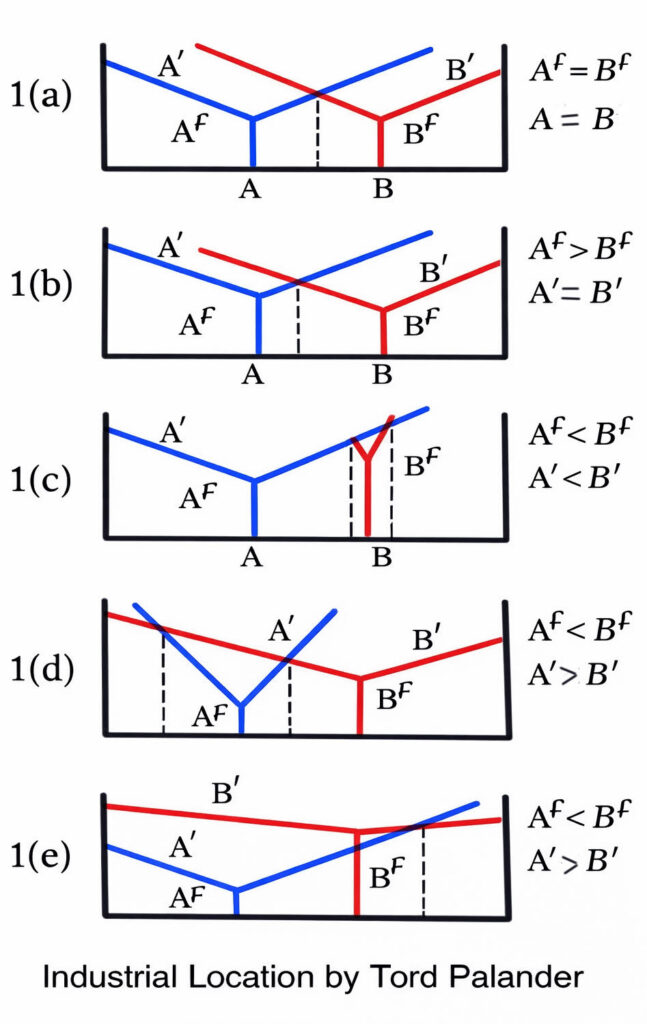
Given the above assumptions, the market area of a firm depends on the total cost of production along with cost of transportation. These costs vary over space. So, a firm with lower cost of production with lower marginal transportation cost will have greater market area than a firm with high cost of production and higher marginal transportation cost. Let us understand this with examples in Figure. 1.
It shows a five cases of variation in cost of production and transportation for two locations i.e. A (Blue) and B (Red). The vertical line is marked with Af and Bf which represents cost of production for A and B, respectively. The taller lines represents higher cost of production and vice versa.. The slanting curves in the figures is marked by A’ and B’ representing variation of transportation cost as we move away from the location of production. The curve with steeper slope represents the higher marginal transportation cost. Contradictorily, the curve with gentler slope represents lower marginal transportation cost. Additionally, the vertical dashed line represents market area boundary between A and B. This line also represents the isodapanes used in Weber’s Theory.
Examples of Determination of Market Area
- In Case 1(a), the Af=Bf and A’=B’, therefore, they are equally competitive. Thus, they share equal market area.
- In Case 1(b), the Af>Bf but A’=B’, therefore, A’s total cost of production is higher whereas the transport cost is same. Hence, B commands greater market area.
- In Case 1(c), the Af<Bf and A'<B’, which results in very low competitiveness from B. Therefore, A commands greater market area whereas the B has very little market area.
- In Case 1(d), B’s cost of production is higher by small margin but has low marginal transport cost in relation to A. So, B commands greater market area due to competitiveness in transportation cost.
- Ultimately in case 1(e), B’s cost of production is higher than A by a large margin. Despite B’s competitive marginal transportation cost, it can not compete with A because A has very low production cost. Overall, A commands most of the market area.
Relevance of Market Area Theory
Tord Palander used a modified version of Weber’s approach in determining industrial location using isodapanes. Isodapanes are the lines joining the location of total cost of sourcing raw materials and delivering a product to market. Palander’s curves in Figure 1 also demonstrate similar operation.
- However, Palander disagrees with Weber on question of effect of agglomeration. He laid more emphasis on inter-firm competition and their market area unlike Weber who emphasized effect of agglomeration economies in determination of location.
- Palander believed that a firm will not relocate to an agglomeration until it is sure that its nearest competitor is also moving to the agglomeration. Relocating alone means leaving the whole market area to its competitor.
- The firms may not be very cooperative to each other even in an agglomeration. So, Palander attaches more importance to competition not cooperation.
- Although, Palander did not directly state it but one can use the idea of varying cost of production over space to include the effect of agglomeration, too, as such location may show low cost of production or low cost of transportation.
- Hence, the market area theory is flexible enough to incorporate various types of variation in cost across geographical space to determine market area.
However, it lacks the humane aspect of decision making where a producer tries to satisfy his need rather than maximize his profits like Smith’s Theory of Industrial Location demonstrates. Smith shows that a producer can locate the firm within a spatial margin of profitability which may or may not be location of maximum profit. It also lack many dynamic macroeconomic processes which impact the location of firm as shown in Hoover’s Theory of Industrial Location.
Conclusion
In short, this theory provides a three dimensional aspect to question of industrial location i.e. variation in cost of inputs at a single location along with variation of cost of production and transportation across different locations. Palander’s cost curves are very novel and useful in determining market area. The users of Palander’s theory may replace the types of cost of production and other variable cost to suit their own objectives. Hence, it is a quantitatively flexible theory.

Kulwinder Singh is an alumni of Jawaharlal Nehru University, New Delhi and working as Assistant Professor of Geography at Pt. C.L.S. Government College, Kurukshetra University. He is a passionate teacher and avid learner.